Stonehenge

Overview

Located about 90 miles west of London, Stonehenge is one of the world’s most famous and mysterious prehistoric monuments. Built around the same time as Egypt’s Great Pyramid, this complex of giant stones, some weighing up to 30 tons, has captivated archaeologists and historians for more than a thousand years .

1440 Findings

Hours of research by our editors, distilled into minutes of clarity.

  • What Stonehenge sounded like

    Researchers built the first scale model of the world's best-known prehistoric stone circle, Stonehenge, to study its acoustic properties. Built approximately 5,000 years ago, the landmark in southern England has puzzled historians for centuries, but...

  • How was Stonehenge built?

    If you can’t quite picture how human beings managed to lug 30-ton stones over miles of prehistoric English countryside and stand them up, this short animation from English Heritage can help. The Stone Age engineering involved using giant wooden rollers and carving precisely interlocking tongue-and-groove joints to hold the heavy stones in place.

    An animation of fictional characters building Stonehenge.
    Video

    How was Stonehenge built?

  • Solstice celebrations live from Stonehenge

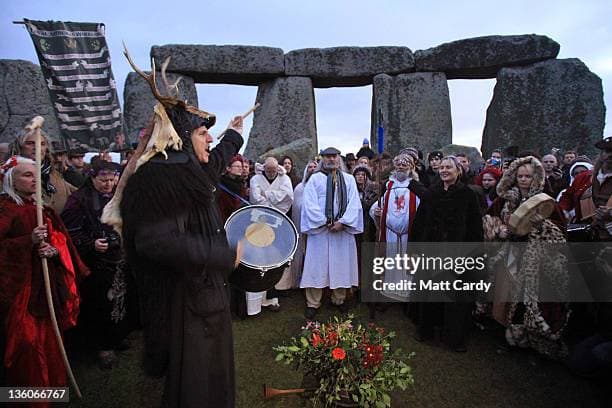
    Every year, some 15,000 people make the pilgrimage to Stonehenge to watch the sunrise on the summer solstice. And hundreds of thousands more watch the event from home, live-streamed on YouTube. Among those that attend solstice celebrations in person are neo-druids in white hooded robes, performing spiritual ceremonies among the stones.

    A graphic banner announcing the online event of the livestream of the Summer solstice celebration at Stonehenge.
    Video

    Solstice celebrations live from Stonehenge

  • A photo gallery of modern-day Druids

    The crowds that gather at Stonehenge for the solstice celebrations are a colorful bunch: Some wear the white robes of modern Druids, carry staffs and wear crowns made of antlers or wildflowers. Some blow through ox horn trumpets to mark midsummer; others just show up with a hula hoop. Getty photographers are on hand to capture all the sights.

  • Archaeologist lays out how Stonehenge was built

    If you ask archaeologist Mike Pitts, the leading theories about how Stonehenge was built are all wrong. Instead of using wooden rollers to transport the sarsen stones, he suspects stone-age builders used sleds, and that they raised them not with long ropes but rather with the same technique islanders used to raise the big stone heads on Easter Island.

  • A playful, bouncy model of the ancient Stonehenge

    Stonehenge is considered a sacred site by many modern-day druids and pagans. Then artist Jeremy Deller came along and recreated the monument as … a bouncy house? The inflatable artwork, measuring more than 100 feet across, invites the public to jump all over this symbol of British national identity. It has been displayed in Paris, in London during the 2012 Olympics and even at Stonehenge itself.

  • Is the sun aligned with Stonehenge right now?

    Twice a year, during the longest day and night, the sun’s path aligns ever so gently with the ruins of Stonehenge. During the summer solstice, viewers can see the sun’s rise crest the central heel stone. The winter solstice sees the sun set across the site’s altar stone. Use this interactive to tour the historic site and check its current skyscape.

  • The mysteries of Stonehenge

    This gallery from Google Arts and Culture lets you explore Stonehenge through archival photographs from the Life magazine collection, contemporary images from Getty, and a Google Earth model of the site that you can spin around and flip to get an aerial view of the layout. There’s even a virtual tour that gets you close enough to see the lichen on the 30-foot-tall sarsen stones.

  • The battle of the beanfield at Stonehenge

    Back in the day, access to Stonehenge was free and open to all; families would picnic there, and there was even a Woodstock-inspired music festival that drew up to 100,000 attendees. Then, in 1985, Margaret Thatcher put the kibosh on the festival, blocking off road access and calling in 1,300 riot police to violently arrest festival goers. This documentary features footage from that day. People have been largely banned from the central part of the monument ever since, except on solstices and equinoxes.

    A still shot from the video of Operation Solstice.
    Video

    The battle of the beanfield at Stonehenge

Explore World History

Weave together the many narratives of world history with our highly curated and expanding selection of diverse, fascinating resources designed to showcase the breadth and richness of Earth's story, from the earliest traces of human civilization to the dramatic developments of contemporary cultures.

View All World History