Gladiators

Overview

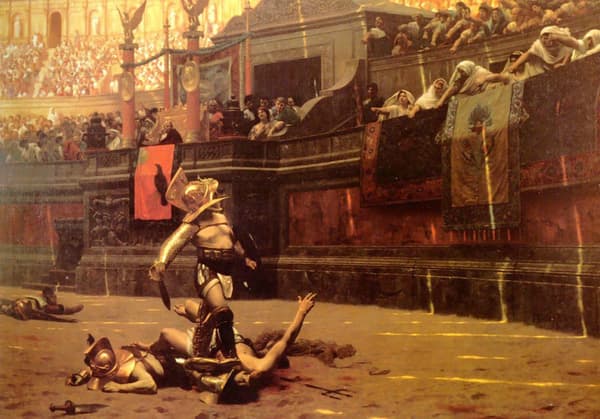
Gladiators, the men and women who fought in public arenas, fascinated the ancient Roman world. Their images appeared in both dive bars and opulent villas. Philosophers moralized about them; children sketched them on walls. For good luck, brides parted their hair with a spear pulled from a gladiator’s corpse.

1440 Findings

Hours of research by our editors, distilled into minutes of clarity.

  • Who was Spartacus, the revolutionary gladiator?

    An article on the career of Spartacus, the gladiator responsible for the biggest slave revolt in Roman history. After breaking out of a school at Capua, Spartacus led an army of slaves that grew to 70,000 and defeated a Roman army sent against him. It took the combined efforts of Crassus and Pompey to subdue him. Ever since the Enlightenment, Spartacus has been regarded as an icon of resistance to slavery and oppression. The Romans, naturally, saw him in a less sympathetic light.

  • Getting good seats at the Colosseum

    A humorous (but historically accurate) look at what it was like to spend a day at the Colosseum. Although admission was free, every spectator had to present a tessera (token) to enter. Seating was segregated by class. Senators occupied comfortable chairs next to the arena; slaves and women were relegated to the highest seats. Although snacks were sold in the stands, people often left for lunch, and sometimes lost their places in the process.

    painting of audience in the colosseum
    Video

    Getting good seats at the Colosseum

  • Primary sources on gladiators

    This article—taken from an old classical dictionary—outlines what ancient texts tell us about gladiators. Although archaeology has come a long way since it was written, the textual evidence has not substantially changed. For a better context, follow words hyperlinked in the article to translations of the original sources.

  • What did it take to eat like a gladiator?

    If you think gladiators were all rippling muscle, think again. Evidence suggests fighters weren't as cut as we've been led to believe. This article dives into the diets of ancient Roman gladiators, who may have eaten mostly vegetarian. Archaeological evidence gathered from the skeletons of 68 gladiators found in a 2,000-year-old Turkish grave suggests the fighters' diets mainly relied on barley and legumes, with little animal protein.

  • A mosaic showing a classic gladiator combat

    This mosaic, now displayed at the National Archaeological Museum in Madrid, is an excellent representation of the iconic retiarius/secutor match-up. The lower panel, chronologically first, shows the two fighters facing off under the watchful eyes of two referees. In the upper panel, one fighter has fallen. The caption reads: Astyanax vicit (“Astyanax won”). The symbol next to his opponent’s name indicates he was killed.

  • A gladiator cemetery at York

    A press release about the discovery of a gladiator cemetery in York, England (Roman Eboracum). The cemetery, in use from the first to the fourth century, contained about 80 skeletons. Analysis of the bones indicated that most belonged to young men who were unusually tall and muscular. Many skeletons bore the marks of fatal wounds; one showed the imprint of a bite from a lion or bear.

  • Spartacus: Enslaved ancient Roman gladiator turned revolt leader

    Sold into slavery and forced to be a gladiator, Spartacus ultimately took the fight outside the arena and revolted against the Romans. This article dives into the history of the rebel leader. Spartacus was originally from Thrace, a part of ancient Europe that included parts of modern-day Bulgaria, Turkey, and Greece. Exactly what led to his enslavement is unclear, but it likely involved ancient Rome's attempt to subjugate Thrace.

  • Female gladiators in the Roman arena

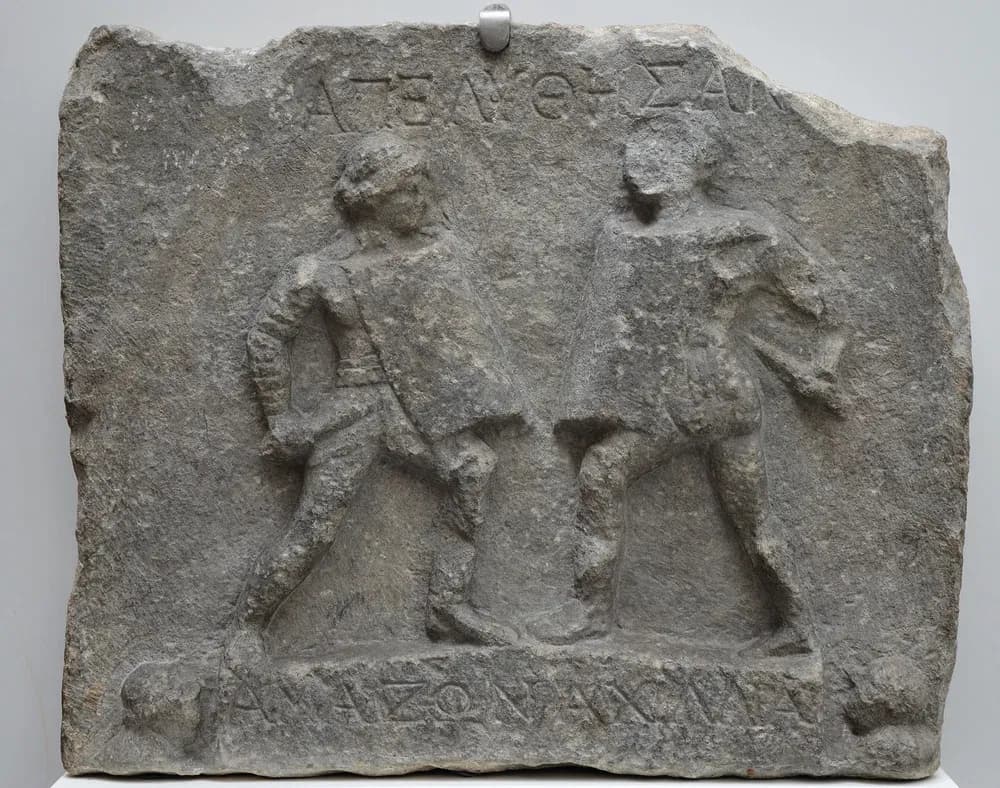
    Although the vast majority of gladiators were male, a few—as this article explains—were female. Female gladiators fascinated and unsettled Roman spectators because they shared the “masculine” courage displayed by their male counterparts. Their stage names likened them to the Amazons and heroines of Greek myth.

  • Gladiators were overweight vegetarians

    This article summarizes the findings made when forensic anthropologists at the Medical University of Vienna analyzed bones from a gladiator cemetery at Ephesus. Gladiators, they discovered, ate very little meat. Despite their largely vegetarian diet, their bones were rich in calcium, apparently due to their practice of drinking wood ash mixed in water. The scientists speculated that the gladiators’ diet may have been intended to make them gain weight as a way of padding their vital organs.

  • The gladiator code of conduct

    Here's a wide-ranging interview with Professor Michael Carter, a leading scholar on gladiators. Among other subjects, the interview explores how the games were paid for and advertised, the existence of gladiator “merch,” whether matches were ever fixed, the rules by which fights were judged, and the remarkable code of conduct that encouraged gladiators to spare their opponents whenever possible.

    professor and toldinstone logo
    Video

    The gladiator code of conduct

Explore World History

Weave together the many narratives of world history with our highly curated and expanding selection of diverse, fascinating resources designed to showcase the breadth and richness of Earth's story, from the earliest traces of human civilization to the dramatic developments of contemporary cultures.

View All World History